A day you can hear and walk into
Each day is two things made from one market close: a piece of music that follows on from yesterday’s, and a tableau that continues yesterday’s picture. The day’s music is laid across its own tableau, so where you are in the picture is where you are in the music.
Left alone, the picture moves at the music’s pace. Take hold of it and it moves with your hand, and the music follows.
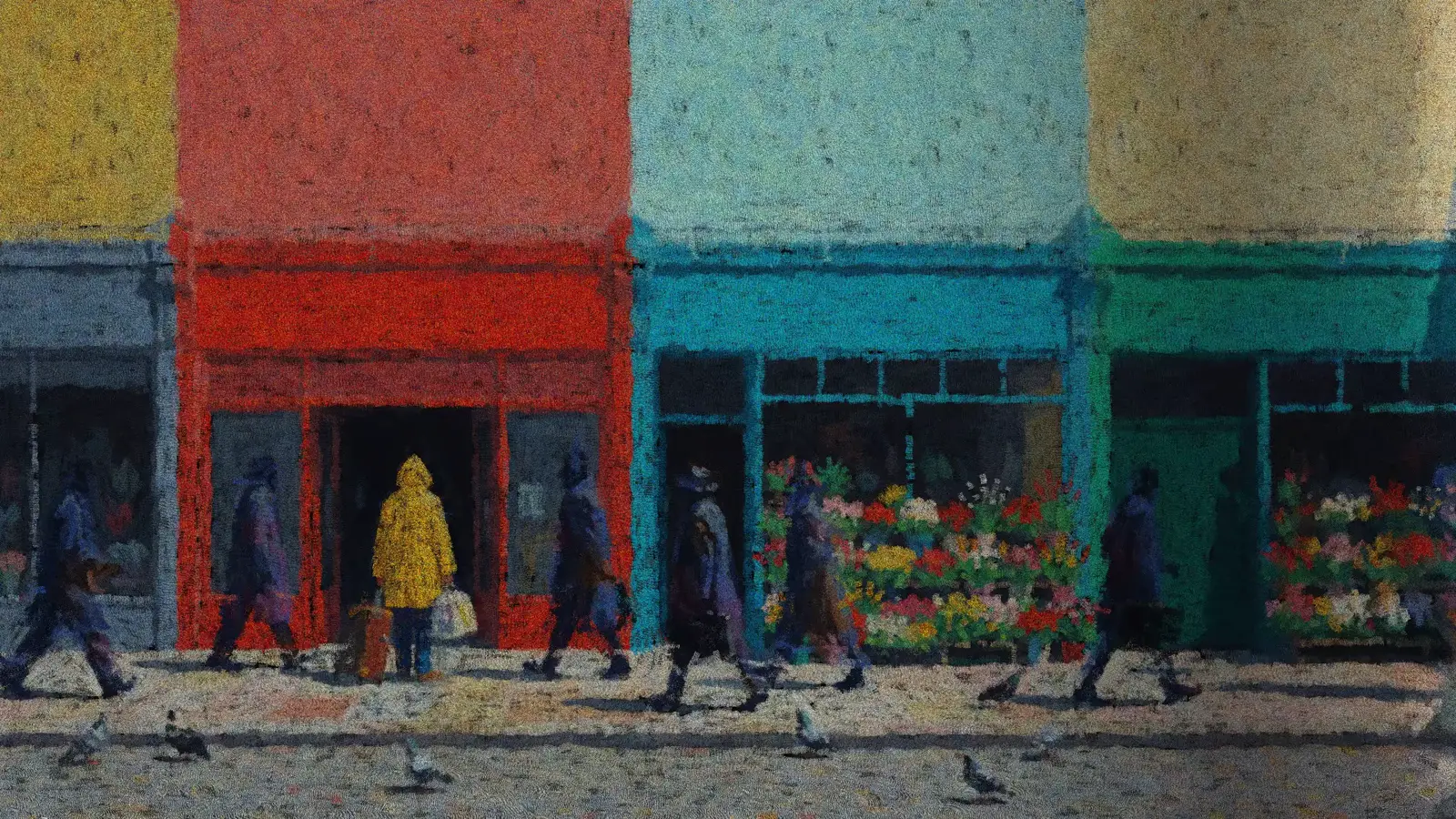
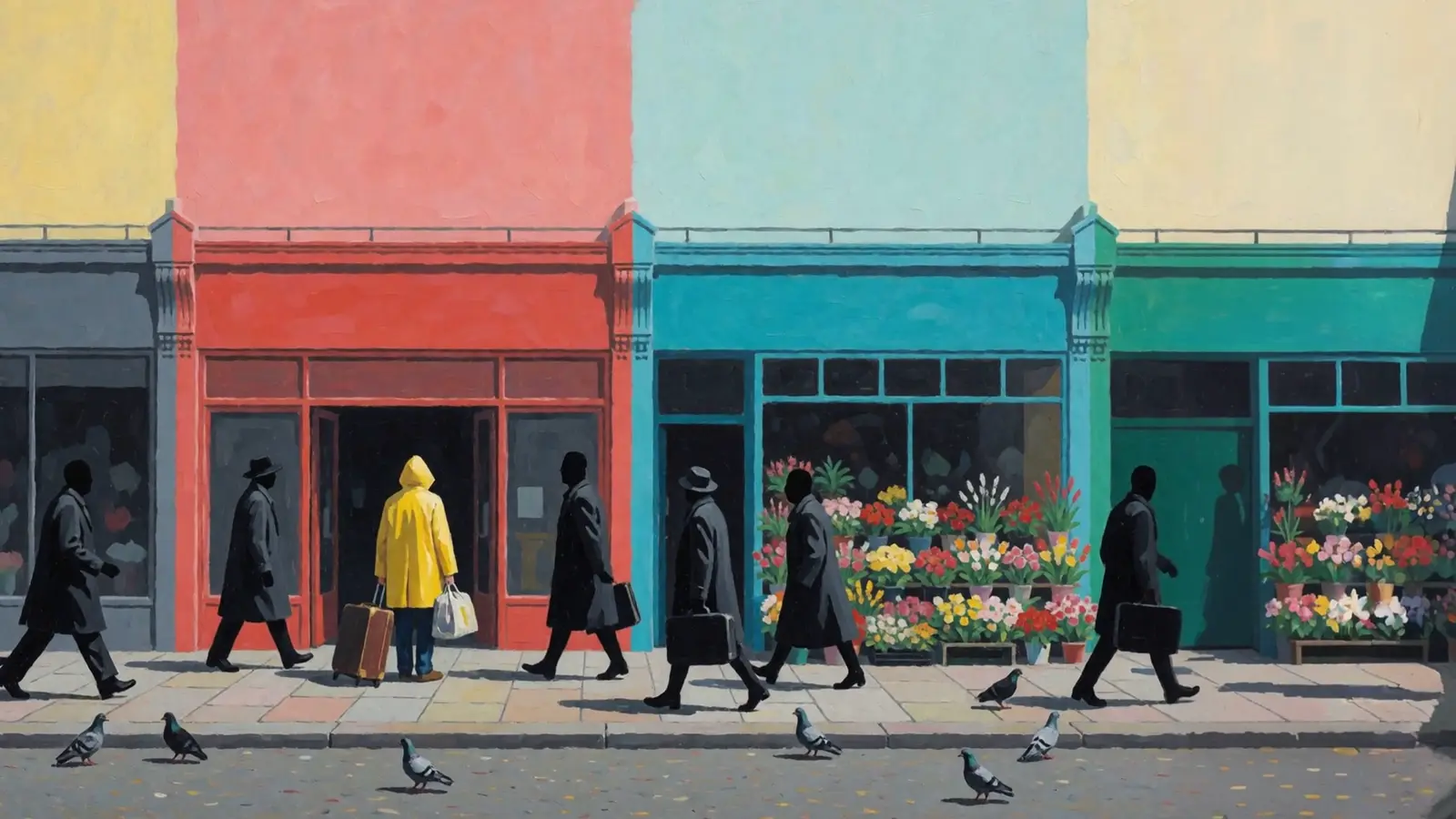
Pictures are studio previews from the Season 4 trailer, made before the season began.
From the close to the reveal
- 1
Market
At 16:00 UTC the PANO/USD change picks the mood.
- 2
Scene
The day’s lead and their part of the story, written for that mood, in the look of their ten days.
- 3
Tableau
Krea 2, an open image model, generates options. One is picked by hand.
- 4
Join
The new tableau is joined to the right edge of yesterday’s, with the seam Seasons 2 and 3 used.
- 5
Depth
The tableau is read for depth and the direction of its forms, and rebuilt as about 52,000 strokes in space.
- 6
Ground and things
The ground is found, and every person, car, table and tree is lifted onto its own layer at the depth it stands.
- 7
Walk
The lead’s way from yesterday’s tableau into today’s is planned over the ground, at the height a person has where they stand.
- 8
Music
Dav makes the day’s piece with the lead’s sounds in the day’s mood. Its notes go into a score the picture reads.
The music
Every sound in the season is Dav’s. Panorama plays no instrument of its own.
Each day’s music comes out of a system Dav built on Ethereum. In his lab he sets the day’s key, records its melody and decides which parts play in each section. From three seeds his contracts write the rest: a path of chords, the bass under it, and kick, snare and hats on loops of their own, pushed a little off the grid where he wants them. His player sounds all eight parts with his BITS samples, held on-chain, and synths of his own.
The music is never stored as sound. A token’s own page asks his contracts for the day’s notes and his player for the sound each time it opens, and plays them there and then.
- Tempo
- Set by the mood, so it changes from day to day.
- Length
- As long as Dav’s piece for the day.
- Joins
- Across the season each day plays once, and its last notes ring on into the start of the next. A token’s own page plays its day on a loop.
- Parts
- Three chord voices, bass, kick, snare, hats and the melody.
What sets a day’s music
- The lead
- Its own sounds: three chord voices, a bass, a kick, a snare and hats.
- The mood
- The tempo, the harmony, how busy the notes and drums are, the effects, and the voice the melody is played in.
- Dav
- The key, the melody, and which parts play in each section of the piece.
- The chain
- The chords, the bass and the drums, written by his contracts from three seeds, so no two days are alike.
How the picture hears it
The picture reads the score the music is made from: where each of Dav’s notes starts and its pitch, and the beat. As the notes reach the middle of the screen, kick and snare make the strokes jump, the three chord voices shift their colour, the bass sways the ground and the melody moves the day’s lead.
The melody is drawn as it plays: a small spark at the note, at the height of its pitch, trailing the lead’s colour that comes apart into drifting motes. Its light falls on the strokes around it and flares on each note. On rising days the trail runs smooth; on falling days it trembles and breaks.
When you scroll, the music comes with you in grains of 90 milliseconds read where the picture is, backwards too. They add up to the same level as the music played straight, so scrolling never turns it down or stops it.
The picture
Each tableau is rebuilt in depth, stroke by stroke, and laid as fine points of colour.
The joined tableau is read for depth with Depth Anything V2 and for the direction of its forms, then rebuilt as about 52,000 strokes standing in space, packed at 15 bytes a stroke. A light falls across them and they cast shadows. The page lays every stroke as fine points of its colour on a near-black ground, the colours split into neighbours with a few complementary flecks. Up close it comes apart into dots; from a step back it is a street.
As the view travels, every stroke moves by its depth: the near pavement streams by, the shopfronts keep pace, the far roofs crawl. Things that stand, a person, a car, a tree, are cut out with Mask2Former and travel as one piece at their own depth, and the place behind them is filled in so nothing tears.
What moves in life moves as one thing: a tree bends from its root in the wind, smoke and steam rise, water falls, laundry and lanterns swing. GroundingDINO and SAM find these in each tableau by name. No car is ever added; only a car the tableau already has may creep forward.
The lead walks from one day into the next. The walker is a puppet built from strokes in the colours of that day’s own figure, posed twelve times a second like stop motion, its feet staying where they land, on the ground the tableau has and at the size a person has there. Where a lead sits or stands out of reach, their strokes travel to the walker as paint. No video model is used anywhere.
Every device draws the same base picture. A computer that can carry more gets every stroke laid, finer shadows and fuller light, and the page measures that rather than guessing from the device’s name.